

MAX Exposure: How Russia Is Inflating the Numbers on Its National Super-App


Russia has long sought to bring its internet under tighter control. MAX, a messaging and services platform launched in March 2025 by the team behind VK, represents the latest instrument of that effort. Promoted as a national super-app, it has been pushed onto users through a combination of official pressure and deliberate obstruction of rival platforms — yet it appears to be struggling to win genuine adoption. OpenMinds analysed dozens of major MAX channels and found various anomalies — including inflated view counts and rates of view accrual incompatible with normal daily use — suggesting an apparent attempt by authorities to manufacture the popularity MAX has so far failed to achieve on its own.
The Russian government has taken a series of deliberate steps to accelerate MAX's adoption. State employees have been required to install the application. Schools, universities and housing management offices have been directed to migrate their official communications to the platform. More recently, authorities have intensified efforts to block Telegram within Russia. By official accounts, the campaign appears to be working: in late March, VK — MAX's parent company — reported 107 million registered users.
Whether MAX has genuinely replaced Telegram as a functional communications platform is a different question. The evidence suggests that much of the reported activity may be artificially inflated.
To assess the platform's development — and the plausibility of its claimed metrics — Telegram offers the most instructive comparison. The two platforms share the same basic architecture: a chronological, non-algorithmic feed of public channels combined with private messaging. Telegram had long been among the most widely used messaging applications in Russia, with a well-developed infrastructure. According to TGStat, there are over 1.6 million channels based in Russia alone; by mid-2025, Telegram's Russian user base had crossed 100 million.
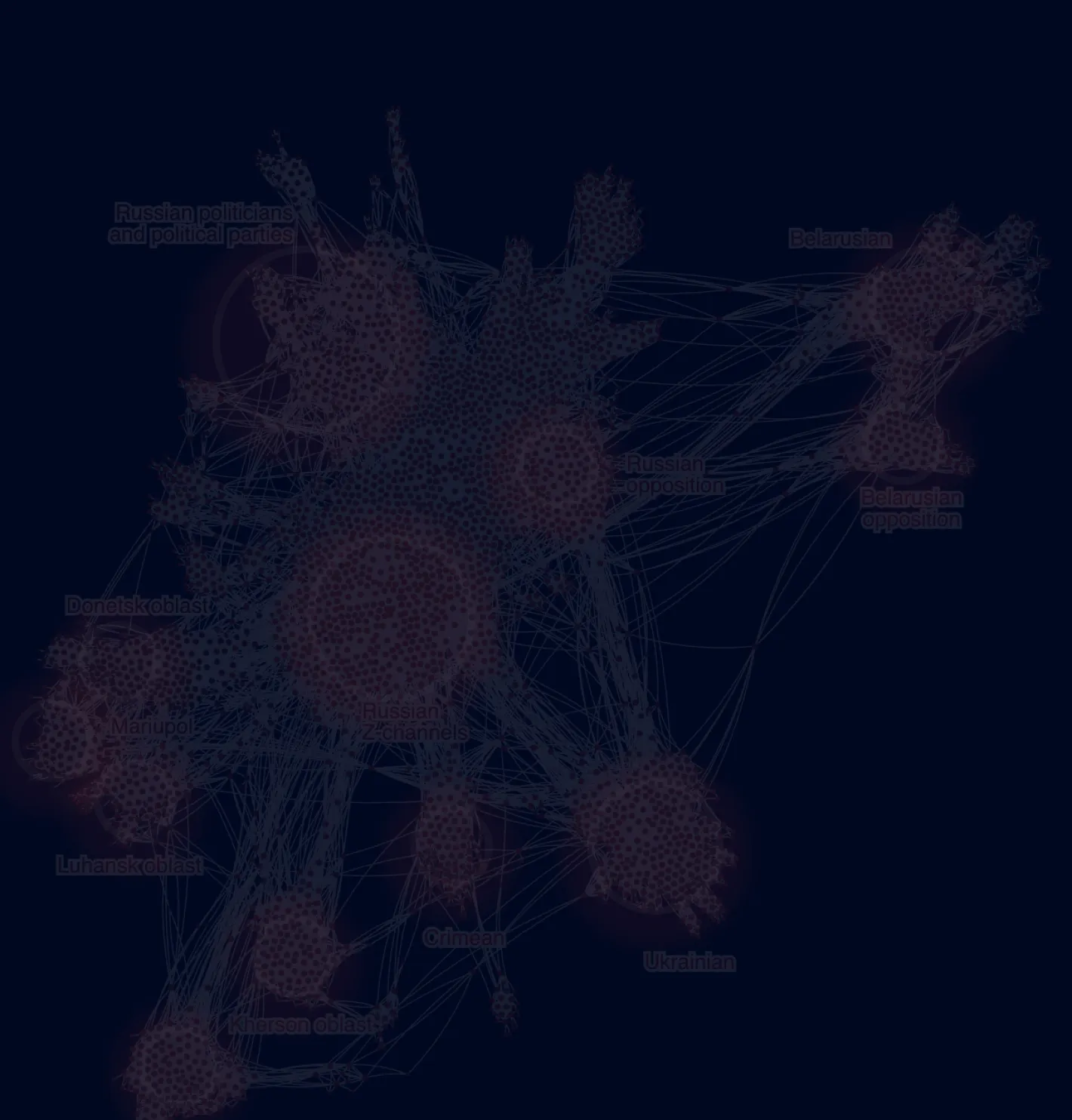
That infrastructure extended to information operations. Telegram had become the primary vehicle for official and covert Kremlin propaganda alike — a dense and interconnected network whose structure our earlier research mapped through audience overlap analysis. War-related propaganda, in particular, was tightly embedded within this broader Russian Telegram ecosystem.
The response among pro-government Telegram channels was predictable. Most moved quickly to redirect their audiences to MAX. Some, like Komsomolskaya Pravda, ran countdowns to an anticipated full Telegram block on April 1st. Others — including TASS, the Ministry of Defence, and the government's own channel — began linking to their MAX presence as a contingency, advising followers what to do if video stopped loading. As Telegram slowed and restrictions tightened, reach on Kremlin-affiliated channels declined. Audiences, however, did not transfer wholesale.
To examine the gap between the two platforms, we assembled a sample of 40 prominent Russian Telegram channels spanning several categories: government bodies, state and Kremlin-aligned media, military correspondents, and news aggregators — all of which had established and were actively maintaining a presence on MAX by late March.
The numbers that don't add up
By the end of April, every channel in the sample had fewer subscribers on MAX than on Telegram. Not one was an exception.
Despite attracting a fraction of their Telegram following, the majority of channels in our sample recorded higher average post views on MAX in late March than they had on Telegram in late January — before the large-scale slowdown of the latter began. Fewer followers, in other words, but apparently more eyes on each post.
The relationship between subscriber counts and average post views offers a further basis for scepticism. On Telegram, a channel is generally considered “healthy” if roughly 30% of its subscribers read any given post. Establishing an equivalent benchmark for MAX is complicated by the platform's novelty, its active government promotion, and its dependence on the success of Telegram's suppression. What the data show, nonetheless, is difficult to reconcile with any organic benchmark: for the majority of channels in the sample, average post views exceed subscriber counts by a factor of several times over. On Telegram, such a ratio would be anomalous for a single channel. On MAX, it is the norm.
There are signs, moreover, that these elevated view counts may not reflect genuine engagement. One important caveat is worth stating upfront: it is not known how MAX counts views. Telegram, for instance, aggregates views across all reposts of a given post, which tends to produce sharp outliers — individual posts that accumulate disproportionately large numbers thanks to wide redistribution. This pattern is clearly visible in the Ministry of Defence's Telegram channel, where the view count per post is punctuated by pronounced spikes.
No such outliers appear in the Ministry of Defence's MAX channel. The view curve is smooth — suggesting that reposts, if they occur at all, have little bearing on the overall figures.
What does stand out, however, is the consistently elevated baseline. Throughout the observation period, average view counts remained high relative to the channel's subscriber base. In one week, average views exceeded 200,000 against a subscriber count of 175,000. That ratio is difficult to explain under normal conditions. It would require either a sustained and unusually high level of interest from non-subscribers — or systematic inflation of view counts to simulate activity on a platform the Kremlin is actively promoting.
The view data from the Russian government's official MAX channel, examined from the moment of its creation, reveals several further anomalies.
When the channel was first established, two early posts — Mishustin's condolences on the death of Tigran Keosayan and his congratulatory message marking RT's twentieth anniversary — attracted unusually high view counts, replicating the outlier pattern typical of Telegram reposts. As the deliberate promotion of MAX intensified, however, such spikes for individual posts ceased entirely.
More telling is what happened on 10th September, the day after the channel's first publication. Within a twenty-minute window, view counts across two separate posts jumped by 15,000 — and then held at that level. The pattern is consistent with artificial inflation almost from the channel's inception.
A third pattern is visible at the tail end of the chart: view counts decline gradually in the weeks closest to the data collection date. This is not, in itself, surprising — recent posts have had less time to accumulate views. What is telling is the scale of the drop, which suggests that views on MAX accrue slowly and unevenly, pointing to an audience that does not engage with the platform daily.
This pattern becomes clearer when view data from the Ministry of Defence's MAX channel is sampled at weekly intervals. For posts published in April, views continued to accumulate over the course of one to two weeks after publication.
Nor is this dynamic confined to government ministries or official channels.
Not a coincidence
Over the course of April, view data was collected from channels in the sample at several different points in time. On average, a post accumulates less than 40% of its total views on the day of publication — assuming that view counts plateau after approximately ten days. Eighty percent of views accrue over five to six days.
This tendency alone does not constitute evidence of manipulation. A gradual accumulation of views is characteristic of platforms with algorithmic feeds, where users may encounter posts published days or weeks earlier. MAX, however, operates a strictly chronological feed — as does Telegram, where 80% of views typically accumulate within a day or two of publication.
Several explanations present themselves. The first is behavioural: most users may interact with MAX infrequently — every few days rather than daily — and upon opening the application, scroll back through the accumulated feed. How many readers, one might reasonably ask, would work their way through five days of unread posts in a chronological news channel.
The remaining explanations are less charitable. The platform may be recording posts as viewed even when a user has not actively read them — a practice that, whatever its technical justification, amounts to a form of artificial inflation. Or view counts may simply be manipulated directly, platform-wide. The two are not mutually exclusive; nor, in their effect, are they meaningfully different.
MAX remains, in important respects, a black box. The platform does not disclose how it counts views, and independent verification of its internal metrics is not possible. What can be observed from the outside, however, is a consistent pattern of anomalies — elevated view counts that dwarf subscriber bases, a rate of view accrual incompatible with a chronological feed used daily, and traces of artificial inflation visible almost from the platform's inception.
These anomalies are not confined to a single channel or category: they appear across state broadcasters, government ministries, military correspondents and news aggregators alike. That breadth makes a purely technical explanation difficult to sustain.
The incentive structure is not difficult to identify. MAX is not merely a commercial product — it is a visible instrument of Russia's broader effort to assert control over its digital infrastructure. For both VK and the Russian state, the pressure to demonstrate success is considerable. Against that backdrop, the claim of 107 million registered users, announced with some fanfare in late March, invites the same scrutiny as the view counts themselves. Registered users, after all, are not the same as active ones — and the data examined here suggest that the audience MAX is said to have captured may, in practice, be considerably more ghost than host.
Methodology
The sample comprises 40 Russian-language channels that had established and were actively maintaining a presence on both Telegram and MAX by the end of March 2025.
Telegram data was collected via the platform's official API. MAX data was provided by TeleZip. Subscriber counts for both platforms reflect figures as of 22nd April. Average view counts on MAX were calculated for the last week of March, based on data collected at the end of April. Telegram view data were collected retrospectively for all channels on 22nd April.

.svg)




.webp)





.avif)












.avif)


.avif)



.avif)








-01-2.avif)
-01.avif)
-01.avif)



-01%25202-p-500.avif)



Join Our Research
If our research areas align and you're interested in joint studies or contributions, we'd be thrilled to discuss potential collaborations.
Use Our Insights
We understand the vital role of media in spreading knowledge and enlightening the public.
If you're in the media and keen on referencing or showcasing our studies, we're eager to collaborate.
Support Our Work
Our strength lies in our diverse funding sources, ensuring we stay independent and true to our mission.
If you would like to support our unbiased research and real solutions to today's propaganda challenges, send request!

Thank you_
For Your Request!
