

1,000 Raids and Counting: Inside Russia's Fastest-Growing Vigilante Network


In early November, more than a hundred masked nationalists marched through the Moscow suburb of Lyubertsy. Local social media channels reported that members of the so-called “Russian Community” organised a patrol across the area. This organisation has repeatedly been involved in acts of self-appointed “law enforcement”. Based on thousands of posts and comments across the “Russian Community” network on VKontakte, now encompassing nearly 1.9 million followers, OpenMinds reveals how a “people’s mutual-aid initiative” has evolved into a coordinated network that normalises ethnic hatred and vigilante violence.
Just a month before the nationalist rally in Lyubertsy, one branch of the Russian Community claimed it had tracked down a man who had escaped from military service at the front and detained him. In May of the same year, in the town of Vsevolozhsk, Leningrad Region, a man of Armenian descent was killed and a woman from Sochi was seriously injured after falling from a window. The incident occurred following a visit by activists from the “Russian Community,” who reportedly claimed they were combating a “drug den” in the apartment.
The main group, “Russian Community,” created in March 2022 shortly after Russia’s full-scale invasion of Ukraine, now has more than 946,000 members. The broader network began expanding rapidly in the second half of 2023, growing into a cluster of 334 interconnected communities and reaching nearly two million subscribers overall, with the largest groups based in Yekaterinburg, Surgut, Magnitogorsk, and Chelyabinsk.
In an interview with the Russian outlet RBC, the co-founder of the “Russian Community,” Andrey Tkachuk, stated that the regional branches are “largely independent” and have their own elected councils. However, Tkachuk himself oversees registered entities: the ANO Russian Media Center (in April 2022), responsible for media operations, and the Community Foundation (in August 2022), which manages events, venues, and training.
The organisation quickly developed a vertical network of regional branches and “militia members,” publicly declaring cooperation with law enforcement and participation in raids, patrols, and “support” for migrant inspections. In several cities, its activists have joined voluntary people’s patrols. This configuration – offices, a media hub, legal entities, and regular joint actions with the police – points to a centralised management model, rather than an independent “grassroots initiative.”
Among posts with identical content across the network, we identified around 1.8K instances of repeated texts distributed top-down – first appearing in the main group and then replicated in regional branches, typically within a single day. This indicates that the agenda is set centrally, while regional pages primarily retransmit pre-produced content.
From Charity to Raids
We analysed content published by the Russian Community to understand the nature of their activities – around 74% of all posts in the Community groups described planned or completed events. The largest share of such posts belonged to the group’s so-called charitable initiatives, accounting for 18% of all posts. More than half of these “charity” posts included references to collecting humanitarian aid for participants in the war in Ukraine.
The sharp rise in charitable activity in October–December 2022 coincided with the surge of volunteer initiatives following the mobilisation and the emergence of the first large, coordinated Russian Community local branches. Since then, the share of “war-related charity” has consistently remained at 9-12% of all posts, which may serve as a tool of legitimation in the eyes of the state and a mechanism of internal mobilisation within the movement.
The second most common type of activity involves internal organisation and operational updates of the Russian Community (16.5% of all posts), which dominated the early stages of the movement’s formation. A central element of this mobilisation is the emphasis on Russianness, traditional values and a patriarchal social order. Recruitment appeals frequently frame participation as a civic and moral duty of “Russian men,” tasked with safeguarding the “people,” “faith,” and “traditional virtues.” One such announcement stated: “We need local coordinators – men ready to work for the community. Those who love the Russian people, who are ready to restore our national character, mutual aid, and our traditional values… We accept applications only from men, because in the Russian tradition it is the man who carries responsibility for his family, faith and Fatherland.”
Sports events (13%) range from large family festivals like the “Russian Yard”, combining first-aid drills, demonstrations by emergency services, and traditional games to father–son shooting competitions and the opening of martial arts clubs promoted as spaces for raising strong, healthy Russian men. Cultural initiatives (12%) include public performances of Russian songs and folk dancing in city centres, as well as festivals where the community showcases traditional food, crafts, and household practices. These events are framed as a way to reconnect young people with “authentic” Russian roots and strengthen a shared ethnic identity. Alongside cultural programming, the movement also organises ideological and moral initiatives, such as social film screenings, for example, the premiere of an anti-abortion drama presented as a call for “moral mobilisation” and the defence of traditional family values. Religious activity (8.5%) includes prayer gatherings and participation in major Orthodox processions. In its coverage of the large Moscow procession with the Kazan icon, the Russian Community amplified narratives about a “spiritual awakening of the Russian people,” promoting claims of 400K participants in contrast to official police figures and presenting the event as evidence of rising national unity.
Over time, however, these community-oriented and culturally rooted activities ceased to constitute the core focus of the network. While they continued to occupy a noticeable share of the content, the priorities of the “Russian Community” gradually shifted. Beginning in late 2023, the group increasingly positioned itself as an actor engaged in maintaining “public order,” emphasising practices that they described as preventive or corrective measures.
Non-State Violence
This trend is reflected in the steady rise of posts covering raids, patrols, inspections, and other actions framed as combating various forms of misconduct. By the third quarter of 2025, this vigilante-style activity had become one of the most prominent types of content, accounting for nearly 20% of all posts – this is about 40% higher than in the beginning of the year.
Over the three-year period, we estimate that the Russian Community carried out no fewer than 1000 raids across the country. More than half of all such actions occurred during the incomplete 2025. Compared to 2024, the number of raids increased by 1.5 times.
Although vigilante-style activity in the Russian Community’s ecosystem is sometimes presented as peaceful or purely “monitoring,” the way these actions are described often downplays the pressure such interventions place on people and institutions. Posts framed as routine “public oversight” may show activists accompanying officials or inspecting institutions – as in a post from the Altai branch, where members took part in checks of women’s health clinics, “monitoring procedures” and issuing symbolic approval marks to medical staff.
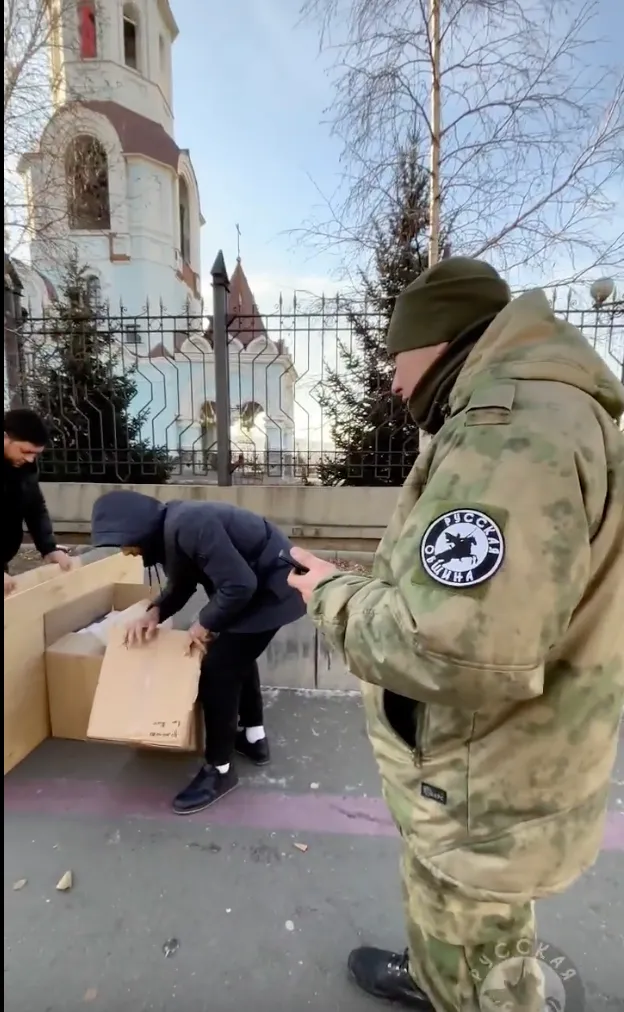
Around 30% of all posts describing such activity contained explicit or implicit signs of violence. These actions were typically directed against individuals labelled by the group as “public order violators” – a category that often included migrants, homeless people, informal street workers, representatives of the LGBTQ community, and other socially vulnerable groups. In this analysis, violence was defined broadly: not only as physical force or detentions, but also threats, humiliation, rhetoric of retribution, and certain forms of pressure that the group describes in softened terms – such as “having a talk,” “explaining things,” or “making someone understand.” These phrases often mask coercive interactions. For example, in one post, Russian Community activists approach street vendors, demand their documents, and the video abruptly cuts to the vendors packing up their belongings and leaving – a sequence presented without any explicit mention of force, but clearly implying pressure that goes beyond a “conversation.”
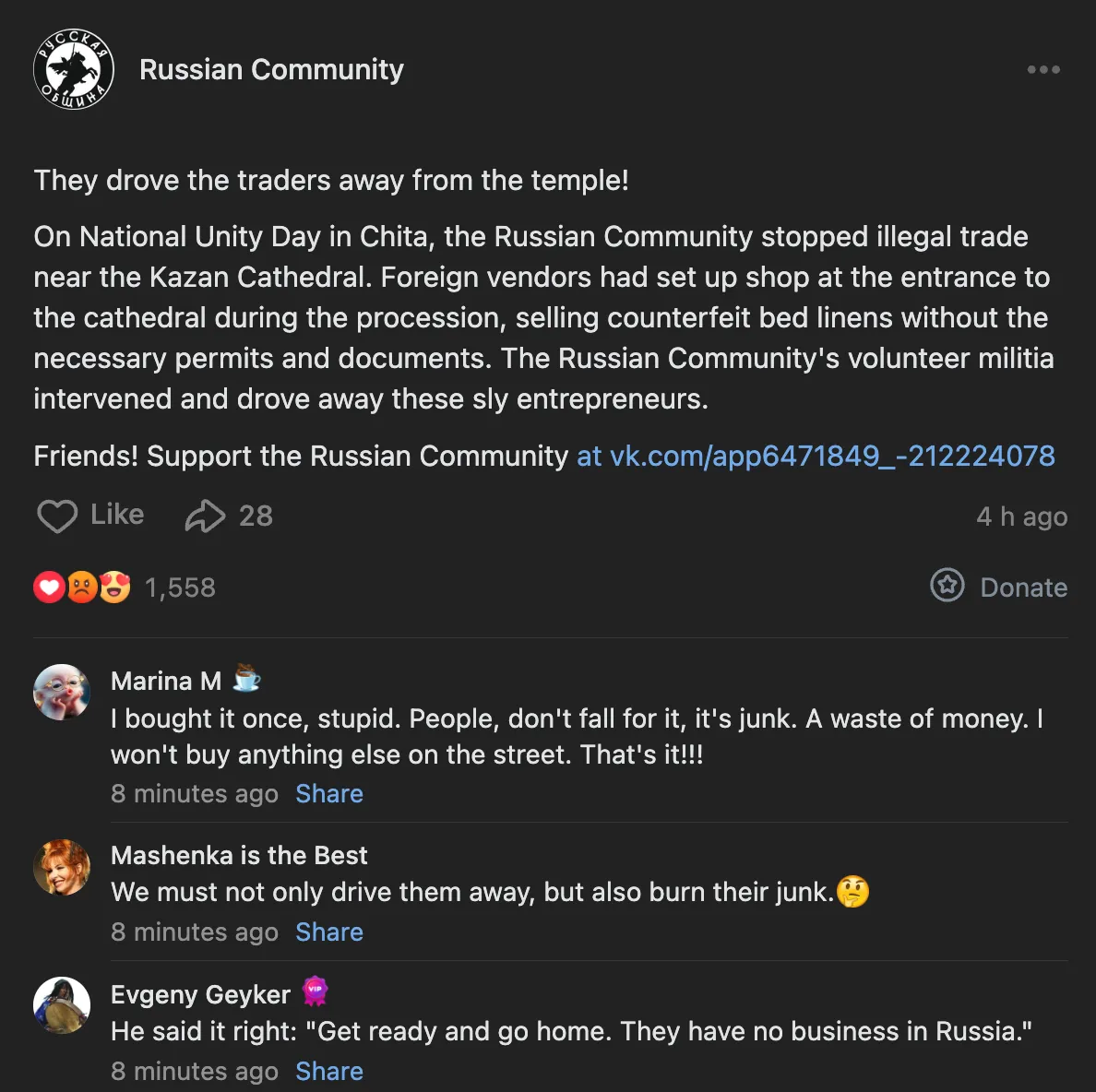
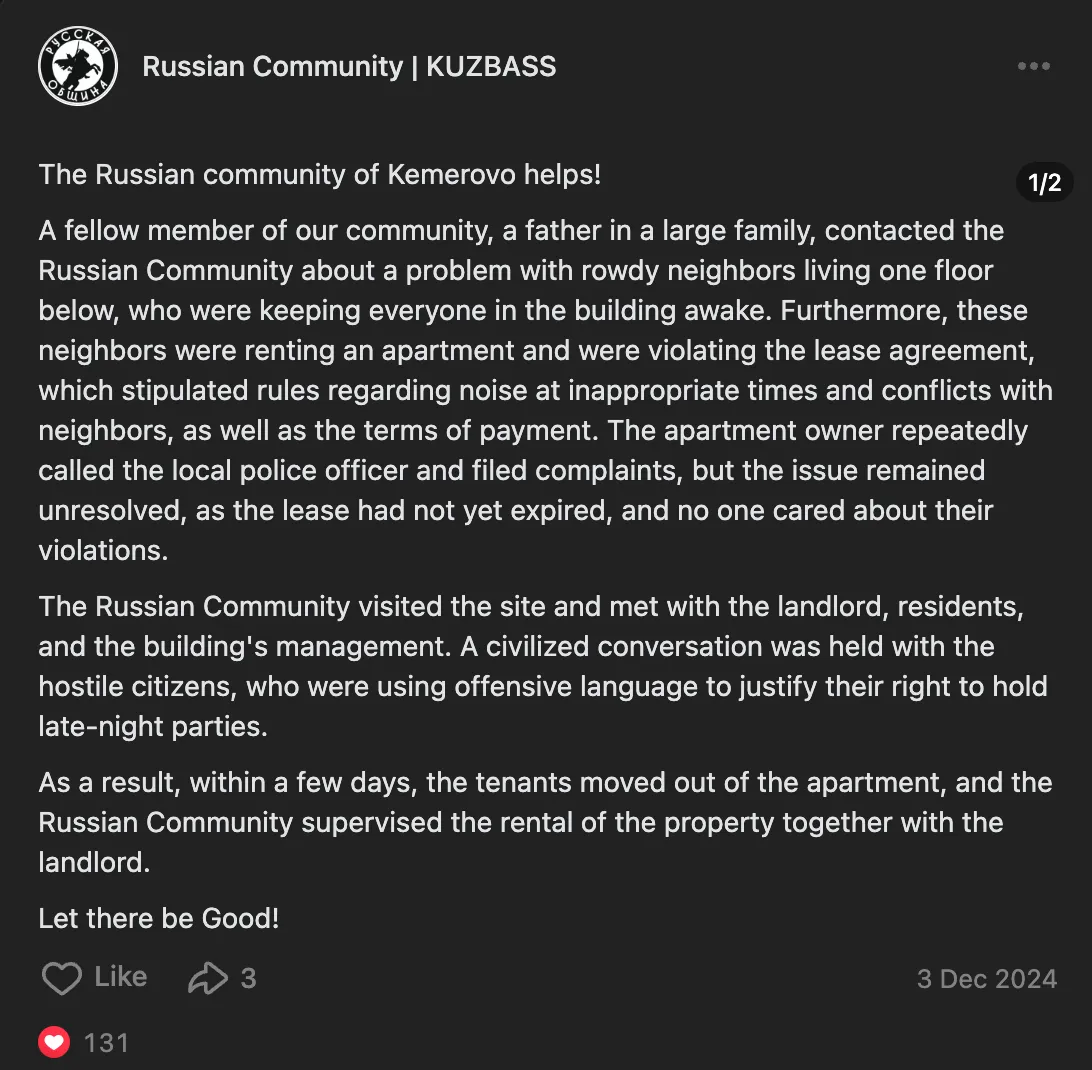
Nearly 80% of vigilante-style activity posts carried a nationalist dimension – targeting migrants or invoking ideas of ethnic purity and the opposition between “us” and “them.” This pattern aligns with broader trends documented by Openminds, which has recorded a sharp rise in xenophobia across Russia, particularly after the Crocus City Hall terrorist attack in March 2024, ranging from escalating hate speech to growing public support for mass deportations. However, Russian Community activists resorted to vigilante violence and intimidation not only against migrants: in about 3.5% of cases, without any mention of the police, they claimed to have dealt independently with drunk, smoking individuals or “inconvenient” neighbors.
Cooperation with the Law Enforcement
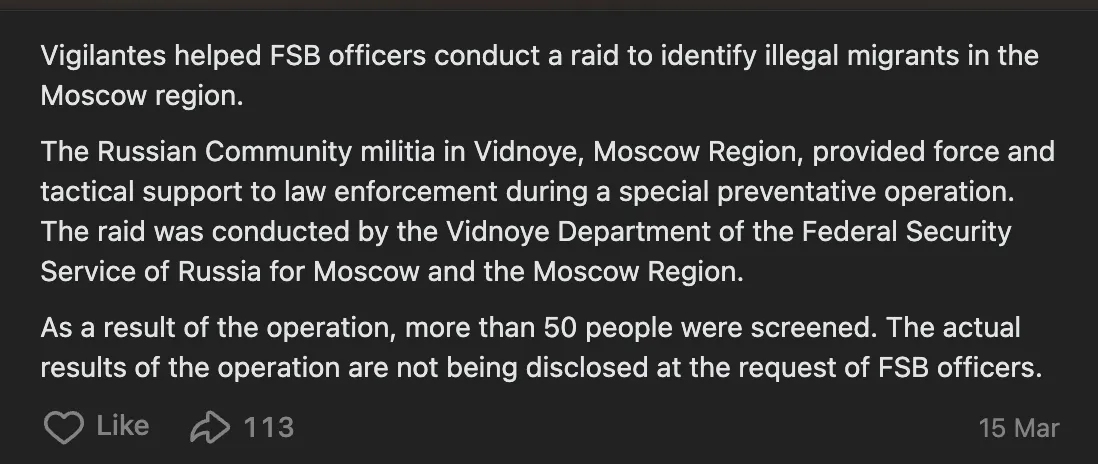
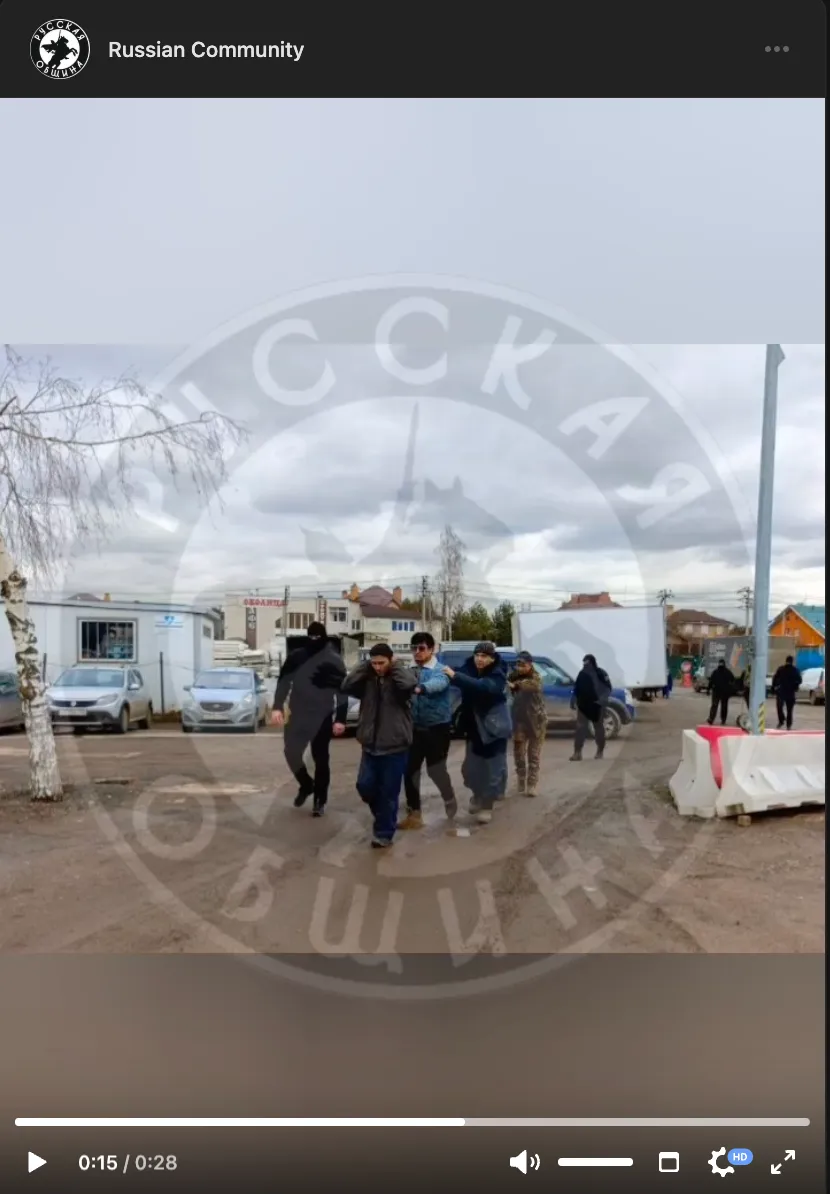
About half of vigilante-style activity involved any cooperation with official law enforcement. When such cooperation did occur, it typically followed one of two patterns: Russian Community members would either identify individuals they deemed to be “public order violators” and hand them over to the police, or they would participate in joint patrols, raids, and detentions.
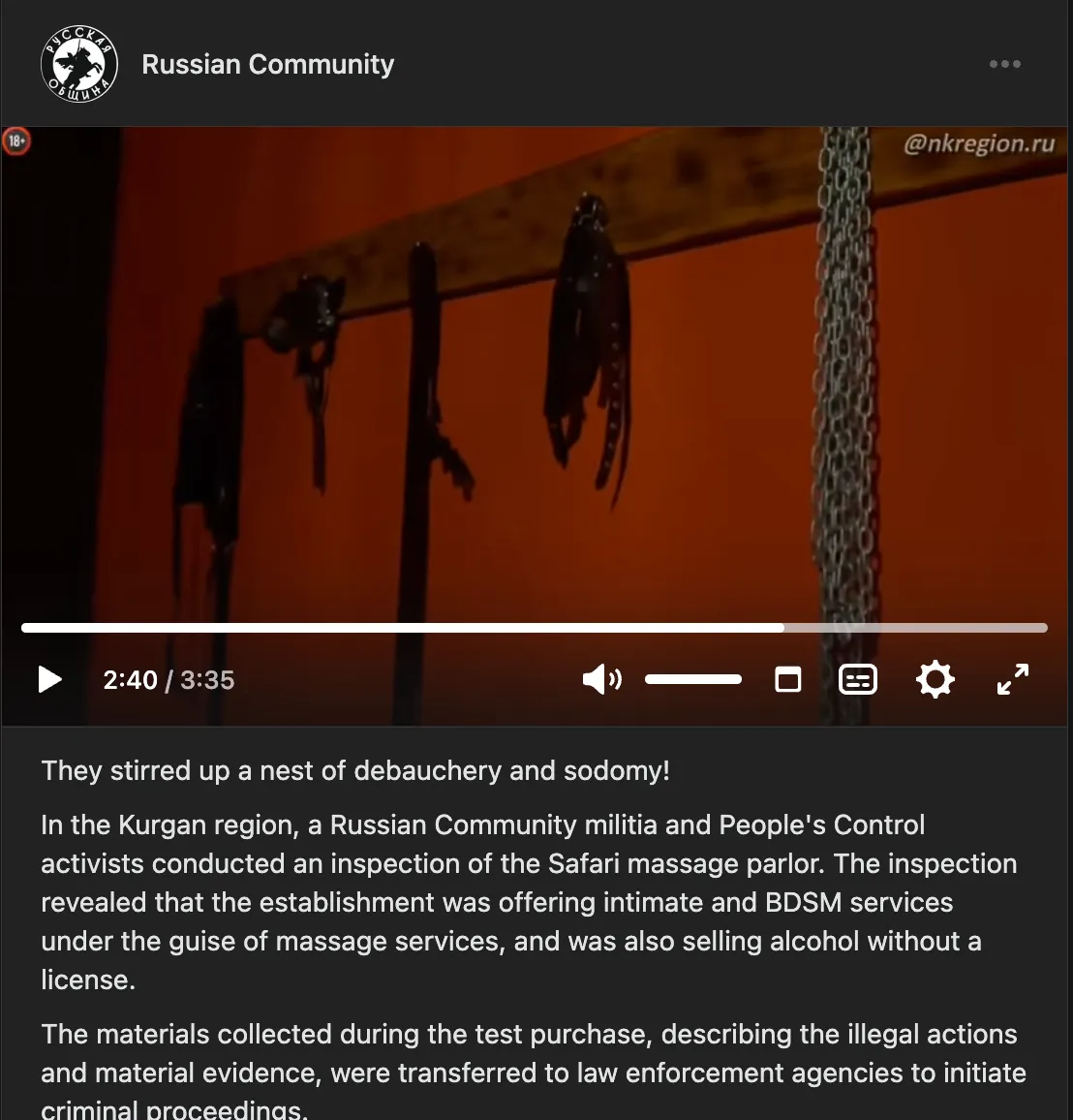
According to the media, this cooperation remains informal and voluntary: regional authorities have not received direct instructions from the Kremlin to work with the group. Sources note that the activities of the Russian Community are convenient for both federal and regional security agencies, as they assist in situations involving “interethnic tensions.” The FSB reportedly provides the movement with information about such conflicts and “keeps the most active nationalists under its wing.” At the same time, the movement’s co-founder has stated that this reliance on the Russian Community also reflects a growing personnel shortage within law enforcement: with severe understaffing in patrol and frontline police units – reaching up to 80% in some regions – local authorities increasingly turn to, or quietly accept, the group’s involvement to fill operational gaps.
Reaction of Audience
Posts related to self-appointed “law enforcement” consistently generate one of the strongest audience responses within the Russian Community network. This category frequently appears among the top performers, often receiving the highest relative views and likes. This indicates that within each community, "law and order action" content tends to significantly outperform the typical post.
Openminds analysed a representative sample of comments on posts about “law and order” actions and found that 23% of them expressed approval and support for such activities, while 71% were neutral (often informational or inquisitive) – indicating a growing normalisation of this kind of behavior within the community. Only 6% of comments contained criticism or disapproval.
Almost a third of all comments contained aggressive language. Around one in five comments expressed nationalist or anti-migrant sentiment, about one in ten included explicit calls for violence, and roughly 15% directly supported vigilante actions. These categories are not mutually exclusive, meaning that a single comment could belong to more than one of these groups.
Among the most common violent expressions were verbs such as “chase out,” “deport,” “beat,” and “kill.” Target groups included primarily migrants, followed by newcomers, Roma, Muslims, Tajiks, Uzbeks, and Azerbaijanis, with illegal workers, police, and diasporas appearing as secondary targets. Ethnic and racial terms such as “churki”, “chernota”, Caucasians, and Asians also appear, indicating that the targets of xenophobia in these communities may not be limited to foreign citizens.
Political Engagement that Aligns with Authorities
Another notable category of activity is political actions. In 2022 and early 2023, this category represented a significant share of the group’s overall content. Most of these posts focused on the Russian Community’s political statements and demands – calling for stricter legislation against abortion, advocating for the “return of compatriots,” promoting petitions and public appeals, campaigning to cancel artists and concerts, opposing LGBT rights, or criticising local officials.
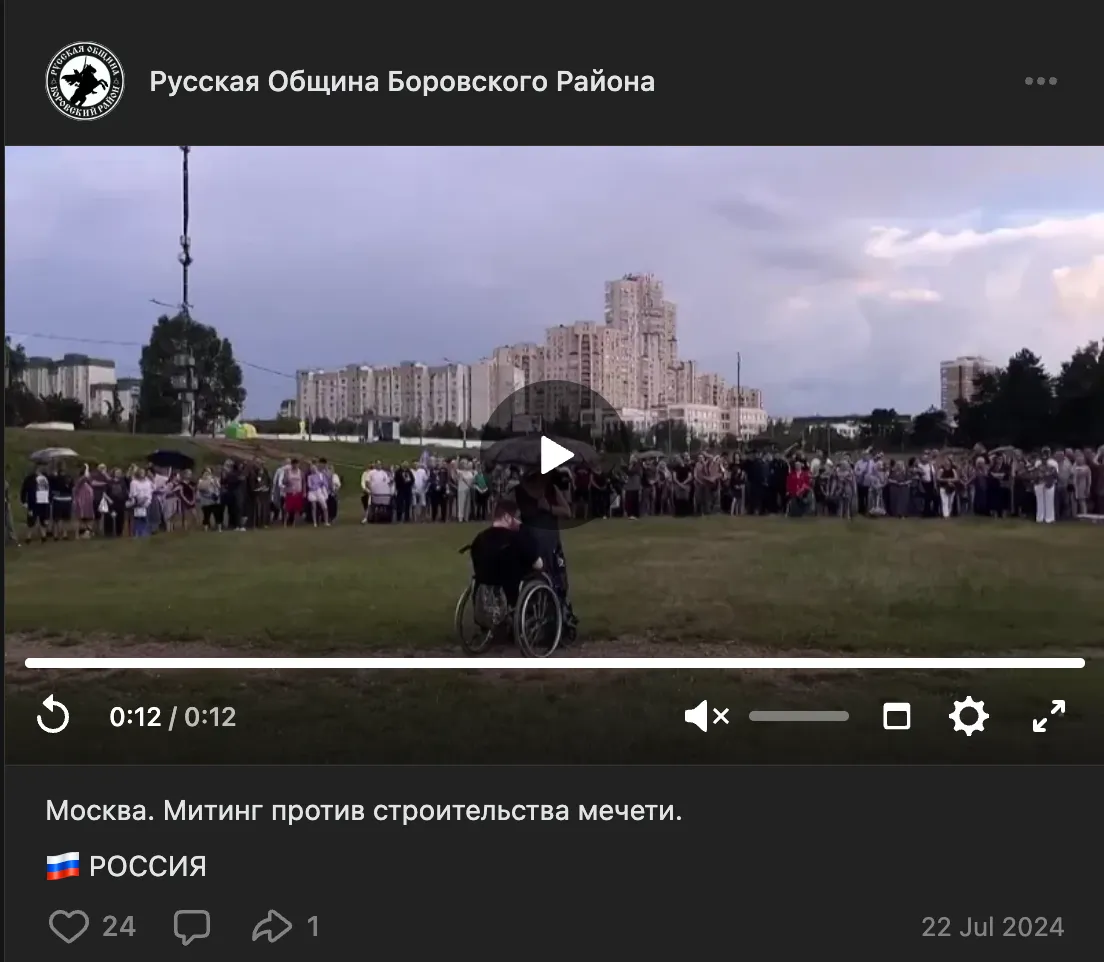
When it comes to street actions, the term protest is not used in the sense of opposition to the Russian government. Instead, it typically appears when referencing protests abroad. Across the entire dataset, we found only a few posts announcing public gatherings against the construction of a mosque, and even in these cases, nothing suggested that the Russian Community itself was involved in organising them.
Among all posts, only 6% contained criticism of the authorities, most of which targeted law enforcement agencies (2%), accused of inaction, ignoring issues related to ethnic crime or migrants, or exhibiting corruption and inefficiency. Local authorities were another target (0.5%), often blamed for failing to address illegal migration and trade.
Criticism of federal institutions was generally non-specific and depersonalised, focusing mainly on migration and demographic policies. Mentions of federal bodies were rare, and criticism of the president appeared in less than 0.1% of posts – it did not call for regime change but rather aimed to draw attention to local problems.
Overall, the Russian Community’s political rhetoric remains loyal to the Kremlin – a sharp contrast with the nationalist movements of the 2000s, which positioned themselves in opposition to the authorities and were quickly suppressed. At the same time, there are emerging signs that the movement may be seeking a growing political role. Media reports suggest that some political parties explored the possibility of cooperating with the Russian Community, although the organisation reportedly declined such proposals. Combined with the rise of nationalist sentiment across the country and the return of war veterans, groups that tend to become politically mobilised, this may indicate a gradual expansion of the movement’s ambitions and capacity.
These shifts reflect a broader trend: in Russia, there is a growing number of structures that carry out mobilisation, ideological work, and “public order” functions outside the formal state hierarchy. In this context, the Russian Community’s activities, its large-scale presence, the normalisation of vigilante practices, and its cooperation with state bodies, point to the formation of a para-institutional actor with its own social and coercive resources. How this resource will be used in the future and whether the movement will remain fully controllable for the state – remains an open question. Yet the strengthening of such formations creates long-term risks, enabling such groups to exert influence both on local processes “from below” and within the political system itself.
Methodology
This study is based on data collected by Openminds from 334 VK groups affiliated with the Russian Community network. Using the VK API, we retrieved and analysed approximately 66K posts published by these groups from the beginning of their activity until September 2025, along with around two million comments and associated engagement metrics such as views, likes, reposts, and comment counts.
To classify the content of posts, we used the Gemini-2.0-Flash model with a structured prompt designed to identify whether a post described a specific action or event, determine the type of activity, and assess whether it substituted state functions, involved cooperation with law enforcement, contained signs of explicit or implicit violence, or included nationalist or anti-migrant rhetoric. Violence was defined broadly: not only as physical force or detentions, but also as threats, humiliation, rhetoric of retribution, or softer formulations that the Russian Community frequently uses to describe coercive interactions, such as “having a talk,” “explaining things,” or “making someone understand.”
For the analysis of audience reactions, we examined a representative sample of 4,1K comments on posts describing “law and order” actions (99% confidence, ±2%). Each comment was processed using a separate schema that identified aggression, calls for violence, nationalist or xenophobic content, the presence of specific target groups, support or opposition to vigilante practices, and the commenter’s overall stance toward the post.

.svg)



.webp)


.avif)








.avif)

.avif)

.avif)






-01-2.avif)
-01.avif)
-01.avif)




-01%25202-p-500.avif)



Join Our Research
If our research areas align and you're interested in joint studies or contributions, we'd be thrilled to discuss potential collaborations.
Use Our Insights
We understand the vital role of media in spreading knowledge and enlightening the public.
If you're in the media and keen on referencing or showcasing our studies, we're eager to collaborate.
Support Our Work
Our strength lies in our diverse funding sources, ensuring we stay independent and true to our mission.
If you would like to support our unbiased research and real solutions to today's propaganda challenges, send request!

Thank you_
For Your Request!
